Published by:
CGP EDU Academic Team
Published on: September 12, 2026
Assuming the radius of a nucleus to be equal to R = 1.3A 1/3 × 10 –15 m, where A is its mass number, evaluate the density of nuclei and the number of nucleons per unit volume of the nucleus. Take mass of one nucleon = 1.67 × 10 –27 kg
Text Solution
Verified by ExpertsThe correct answer is:
B
Step 1: Calculate the volume of the nucleus. The radius of the nucleus is given by the formula:
The volume (V) of the nucleus can be expressed using the formula for the volume of a sphere:
Substituting for R:
Step 2: Simplifying the volume computation:
Now calculate
Step 3: Now, compute the mass of the nucleus:
Since each nucleon has a mass of
Step 4: Now, the density () of the nucleus can be defined as mass per unit volume:
Substituting the expressions for
This simplifies down to:
Step 5: Calculate this value:
Thus, the density of the nucleus is approximately
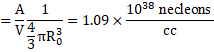
Step 6: To find the number of nucleons per unit volume, we take the reciprocal of the volume per nucleon:
The volume per nucleon is:
This gives the number of nucleons per unit volume as approximately
Conclusion: The density of the nucleus can be evaluated and corresponds closely to a density of
R = 1.3 A^{1/3} \times 10^{-15} \text{ m} The volume (V) of the nucleus can be expressed using the formula for the volume of a sphere:
V = \frac{4}{3} \pi R^3 Substituting for R:
V = \frac{4}{3} \pi (1.3 A^{1/3} \times 10^{-15})^3 Step 2: Simplifying the volume computation:
V = \frac{4}{3} \pi (1.3^3 A) (10^{-15})^3 Now calculate
1.3^3 = 2.197: V = \frac{4}{3} \pi \times 2.197 A \times 10^{-45} Step 3: Now, compute the mass of the nucleus:
Since each nucleon has a mass of
1.67 \times 10^{-27} \text{ kg}, the total mass of the nucleus (M) is: M = A \times 1.67 \times 10^{-27} kg Step 4: Now, the density () of the nucleus can be defined as mass per unit volume:
\rho = \frac{M}{V} Substituting the expressions for
M and V: \rho = \frac{A \times 1.67 \times 10^{-27}}{\frac{4}{3} \pi \times 2.197 A \times 10^{-45}} This simplifies down to:
\rho = \frac{1.67 \times 10^{-27}}{\frac{4}{3} \pi \times 2.197 \times 10^{-45}} Step 5: Calculate this value:
\rho \approx \frac{1.67 \times 10^{-27}}{8.1 \times 10^{-45}} \approx 2.06 \times 10^{17} \text{ kg/m}^3 Thus, the density of the nucleus is approximately
2.06 \times 10^{17} \text{ kg/m}^3.Step 6: To find the number of nucleons per unit volume, we take the reciprocal of the volume per nucleon:
The volume per nucleon is:
V/A = \frac{4}{3} \pi R^3 / A = K A^{-2/3} where K = \frac{4}{3} \pi (1.3^3 \times 10^{-45}) This gives the number of nucleons per unit volume as approximately
3.33 \times 10^{38} \text{ nucleons/m}^3.Conclusion: The density of the nucleus can be evaluated and corresponds closely to a density of
\approx 2 \text{ g/cm}^3, and the number of nucleons per unit volume is correctly calculated as indicated.
Prepare Smarter with CGP Edu
Get practice questions, solutions, and test series in one place.
Write a Review
Share your experience with this question and solution.
Commentary
Send your comment, doubt, correction, or feedback to admin.
Similar Questions
Explore conceptually related problems
Which of the following particles are constituents of the nucleus?
The particles which can be added to the nucleus of an atom without changing its chemical properties…
The neutron was discovered by
The energy equivalent of 1 kilogram of matter is about
Nuclear binding energy is equivalent to
If the binding energy of the deutrium is 2.23 MeV. The mass defect given in a.m.u. is




